
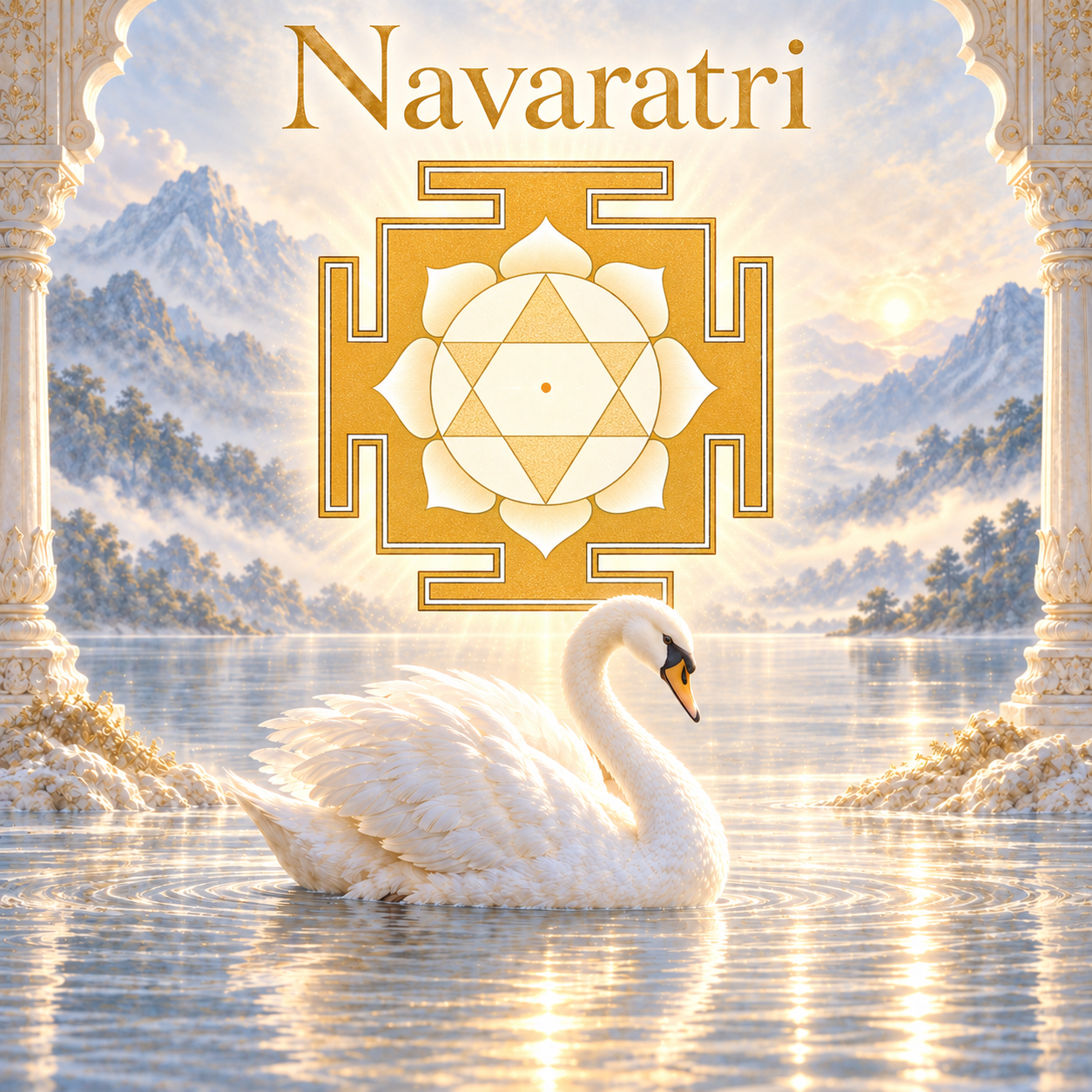
The Inner process of Spiritual Transformation
This October, we came together for ten days of Navaratri sadhana, followed by the celebration of Vijayadashami. Each morning and evening, we gathered for mantra chanting, kirtan and meditation, sharing in one of the most profound traditions of spiritual practice.
Nearly forty people participated from different parts of the world. Some joined us live, while others followed the recordings in their own time. Despite the distances between us, there was a wonderful sense of closeness and connection, which seemed to deepen as the days progressed.
What made this Navaratri particularly meaningful for me was witnessing how the continuity of sadhana brought us together. We were not simply attending an online programme or learning about spiritual practices. We were participating in a living process of transformation, returning each day to our mantras, our sankalpa and our aspiration for spiritual awakening.
As we moved through the three stages of Navaratri, from Durga to Lakshmi and finally Saraswati, the teachings of the three gunas became more than philosophical concepts. Through our daily practice, we had the opportunity to observe tamas, rajas and sattwa within ourselves and experience how these forces influence our minds, emotions and consciousness.
For me, this is the beauty of Navaratri. Its ancient wisdom is not confined to scripture, ritual or tradition. It comes alive through sadhana, through our own experiences and through the changes that gradually take place within us.
I would like to share something of this deeper process of transformation, which lies at the heart of Navaratri, and why this ancient tradition remains so relevant to our spiritual lives today.
Navaratri is one of the most ancient and profound traditions of spiritual sadhana, dedicated to the awakening of the divine consciousness within. Rooted in the timeless wisdom of the Vedic and Tantric traditions, Navaratri is much more than a celebration of the Divine Mother. It is a systematic process of inner transformation, purification and spiritual awakening, through which we gradually move beyond the limitations of our mind and personality towards the experience of our true nature and the presence of God within all creation.
The nine nights of Navaratri represent a passage through the three fundamental qualities of nature, known as the gunas: tamas, rajas and sattwa. These three qualities are present throughout the universe and within every aspect of our physical, mental and spiritual existence. They influence our thoughts, emotions, behaviour, relationships and perception of the world.
Through the mantras of Durga, Lakshmi and Saraswati, we learn to recognise, understand and transform these qualities within ourselves. Each aspect of the represents a different stage in the evolution of consciousness, and each has an essential role in our spiritual development.
Navaratri is therefore an opportunity to awaken and experience divine presence within our own being.
Durga – Transforming Tamas: The Courage to Awaken
The first stage of Navaratri is dedicated to Durga, the power of transformation, protection and the removal of obstacles.
Durga is associated with tamas, the quality of inertia, darkness, ignorance and limitation. Tamas is necessary for rest, stability and the maintenance of physical existence, yet when it dominates our personality, it can manifest as fear, lethargy, attachment, confusion, resistance to change and an inability to recognise our deeper spiritual potential. The transforming power of Durga mantras begins when we develop the courage to look within ourselves. Through sadhana, we start to recognise the habits, conditioning and patterns of thought that keep us bound to limited ways of living and perceiving. We begin to see the many faces of our own personality, including those aspects we would rather avoid.
Durga represents the strength required to face these limitations, not through rejection or self-condemnation, but through awareness, determination and the willingness to change. Her power removes the obstacles that prevent the awakening of higher consciousness. During our first three days of Navaratri, through the chanting of the Kunjika Stotram, Durga mantras, kirtan and meditation, we began this process of purification. We established our sankalpa and directed our minds towards the deeper purpose of sadhana. The darkness of tamas is not something to fear. It is the beginning of transformation. Just as a seed rests within the darkness of the earth before germination, the potential for spiritual awakening is already present within us, waiting for the right conditions to emerge.
Lakshmi – Transforming Rajas: The Awakening of Spiritual Beauty
The second stage of Navaratri is dedicated to Lakshmi, the expression of beauty, abundance, vitality and spiritual prosperity.
Lakshmi is associated with rajas, the quality of movement, activity, desire and dynamism. Rajas provides the energy necessary for action, creativity and change. Yet when uncontrolled, it produces restlessness, ambition, dissatisfaction, attachment and the constant movement of the mind towards external experiences. The transformation of rajas does not mean suppressing our energy or withdrawing from life. It means learning to direct that energy towards a higher purpose. Through Lakshmi sadhana, the energy that was previously scattered through desires, expectations and external pursuits gradually becomes focused, refined and constructive. We begin to recognise that true prosperity is not measured by material possessions or achievements, but by the richness of our inner life. The qualities of kindness, generosity, contentment, compassion, beauty and positive connection begin to emerge naturally when our energy is directed towards spiritual development.
During the four days of Lakshmi sadhana, we deepened our practice of mantra, kirtan and Hridayakasha Dharana, bringing our awareness into the inner space of the heart. The heart became a place of transformation, where the restless movements of the mind could gradually give way to a more expansive experience of life. The seed that had begun to awaken during Durga sadhana was now receiving the energy and nourishment required for growth. Lakshmi represents the flowering of our positive qualities, the awakening of spiritual wealth and the recognition that life itself is an expression of divine energy.
Saraswati – Awakening Sattwa: The Light of Wisdom
The final stage of Navaratri is dedicated to Saraswati, the embodiment of knowledge, wisdom, purity, creativity and higher consciousness. Saraswati is associated with sattwa, the quality of luminosity, balance, purity and understanding. When sattwa becomes predominant, the mind develops the capacity to perceive life with greater awareness and discrimination. The disturbances created by tamas and rajas begin to diminish, and the natural luminosity of consciousness becomes more apparent.
Saraswati represents the awakening of inner wisdom, not merely intellectual knowledge acquired through books and study, but the knowledge that arises through direct experience. During the final three days of our Navaratri sadhana, we moved from Hridayakasha Dharana towards Chidakasha Dharana, directing awareness into the vast inner space of consciousness. Through Om chanting, Saraswati mantras, meditation and the continued practice of Kunjika Stotram, we turned our awareness from the external world towards the source of knowledge within. The symbolism of the seed continued to unfold. What began in darkness, and was nourished through movement and growth, now had the potential to flower in the light. Saraswati reminds us that wisdom is not something we need to acquire from outside. Its potential already exists within every human being. Through sadhana, the mind becomes a more receptive instrument through which that wisdom can be expressed.
Yet even sattwa is not the final destination. The ultimate purpose of spiritual life is to transcend all three gunas and experience the pure consciousness that exists beyond the changing qualities of nature.
The Inner Meaning of Navaratri – From the Gunas to the Divine
The movement through Durga, Lakshmi and Saraswati is not a division into three separate experiences. It is one continuous process of transformation. Tamas is transformed from inertia and ignorance into stability and the determination to awaken. Rajas is transformed from restlessness and desire into purposeful action, creativity and spiritual aspiration. Sattwa brings the luminosity, purity and wisdom through which consciousness can recognise its own deeper nature. All three qualities belong to Prakriti, the manifest world of nature, and all three are present within us at every moment.
The purpose of Navaratri sadhana is to work consciously with these forces, gradually refining our personality and allowing the higher dimensions of our being to emerge. This is why Navaratri is such a powerful period for spiritual practice. Through the repetition of mantra, the discipline of daily sadhana, the concentration of the mind and the experience of meditation, we create the conditions for an inner change that cannot be produced through intellectual understanding alone. We do not simply learn about transformation. We participate in it.
The power of mantra is especially significant. The Kunjika Stotram, often described as the key to unlocking the deeper power of the Devi Mahatmyam, became a central thread throughout our sadhana. A key opens a door. In the same way, mantra becomes a means of opening the inner dimensions of awareness that are ordinarily hidden beneath the activities of the mind. With repetition, sincerity and continuity, sadhana begins to influence not only the moments spent in practice, but also the way we think, feel, act and relate to the world around us.
Vijayadashami – The Victory of Inner Light
Following the nights of Navaratri, Vijayadashami celebrates the victory of light over darkness, wisdom over ignorance and the awakening of divine consciousness over the limitations of the ego. It represents the culmination of the transformative process. Yet this victory is not the destruction of one part of ourselves by another. It is the gradual recognition that beyond the changing movements of the mind, beyond the three gunas and beyond the identities we carry, there exists a deeper reality that is pure, luminous and universal. This is the essence of spiritual awakening. The ultimate purpose of Navaratri is not simply to become a better person, although positive changes in our personality are an important part of the process. Its highest purpose is to bring us towards the direct experience of the divine presence within ourselves and within all existence. This is the experience towards which the ancient spiritual traditions have always directed human aspiration.
The Power of Collective Sadhana
During our ten days of Navaratri, followed by Vijayadashami, we experienced another important dimension of this ancient tradition: the power of practising together. Although participants joined from different countries, cultures and time zones, there was a remarkable feeling of connection through the shared rhythm of mantra, kirtan and meditation. Each morning and evening, we returned to the same practices, strengthening our sankalpa and becoming part of a collective experience of sadhana. The discipline of returning to practice day after day is itself transformative.
Through sangha, the individual effort of each practitioner becomes part of something greater. The sincerity, concentration and aspiration of the group contribute to an atmosphere conducive to deeper spiritual experience. What became particularly meaningful was the recognition that geographical distance does not prevent a genuine experience of spiritual connection. Whether practising together live or following the recordings at another time, we were united through the same mantras, the same intention and the same aspiration towards spiritual awakening. In this way, Navaratri reminds us of the importance of bringing spiritual practice into our daily lives and maintaining our connection with the wisdom of the yogic tradition.
The Sadhana Continues
Navaratri may take place over a particular period each year, but the process it represents continues throughout our lives. Every day we encounter tamas, rajas and sattwa within ourselves. Every day presents opportunities to transform ignorance into awareness, restlessness into purposeful action and knowledge into wisdom. Durga, Lakshmi and Saraswati are not merely forms to be worshipped during a festival. They represent living powers of transformation that can awaken within us through sincere and continuous practice. The real fulfilment of Navaratri comes when the experience of sadhana begins to express itself in our thoughts, actions, relationships and connection with the natural world. The journey from darkness to light is ultimately the movement from separation towards the recognition of unity. And through that recognition, we begin to experience the divine presence not only within ourselves, but within every expression of life. This is the beauty and profound purpose of Navaratri: the transformation of human nature and the awakening of divine consciousness through sadhana.
Hari Om Tat Sat.